Fragmented today
- CRO app
- Upsell app
- Analytics app
- Email app
- Recovery app
- Subscription app

Uddom exists because growing a Shopify store should not mean stitching together five apps that never talk to each other.
Merchants usually end up with a separate app for conversion, upsells, analytics, email and subscriptions. Each one has its own dashboard, its own data and its own bill — and none of them can see what the others did.
These are the constraints Uddom is built to, and the reasons a few features behave more conservatively than you might expect.
CRO, offers, upsells, analytics, A/B testing, email and subscriptions configured in one place, instead of one tab per app.
Built on the app-embed model rather than Dawn-only selectors. If a host element is missing, the module renders nothing instead of breaking the page.
A metric with too little data reads as not measured, never as a misleading zero. Attributed revenue is reported net of refunds.
Discounts run as Shopify Functions at checkout and plans and billing belong to Shopify — Uddom never holds a card or charges a customer.
Install the app, enable the embed once, and everything after that is a toggle and a field in the admin.
Every module is switched on individually, with its own settings and its own plan label, so nothing is a black box.
Shopify's reference theme
Built on the same app-embed model
Adapter-based storefront integration
Fail-safe: no host, no injection
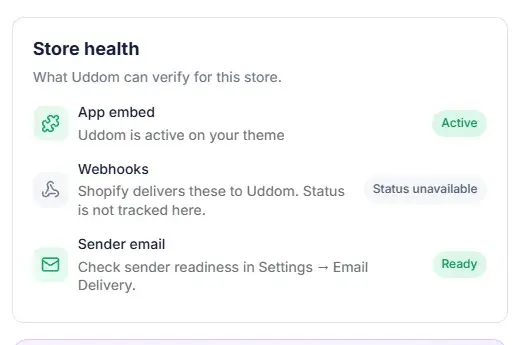
The dashboard reports what is connected and what still needs doing — the app embed, the modules that are live, and the health of the store’s setup — so a new store is not a blank page.
Browse every module, or start on the free plan and add what you need.